
A Reproducible arXiv-to-BibTeX-to-PDF Citation Workflow
Ground an AI-assisted citation in an exact arXiv identifier, preserve the metadata and file diff, and compile the manuscript without confusing a clean build with scholarly verification.
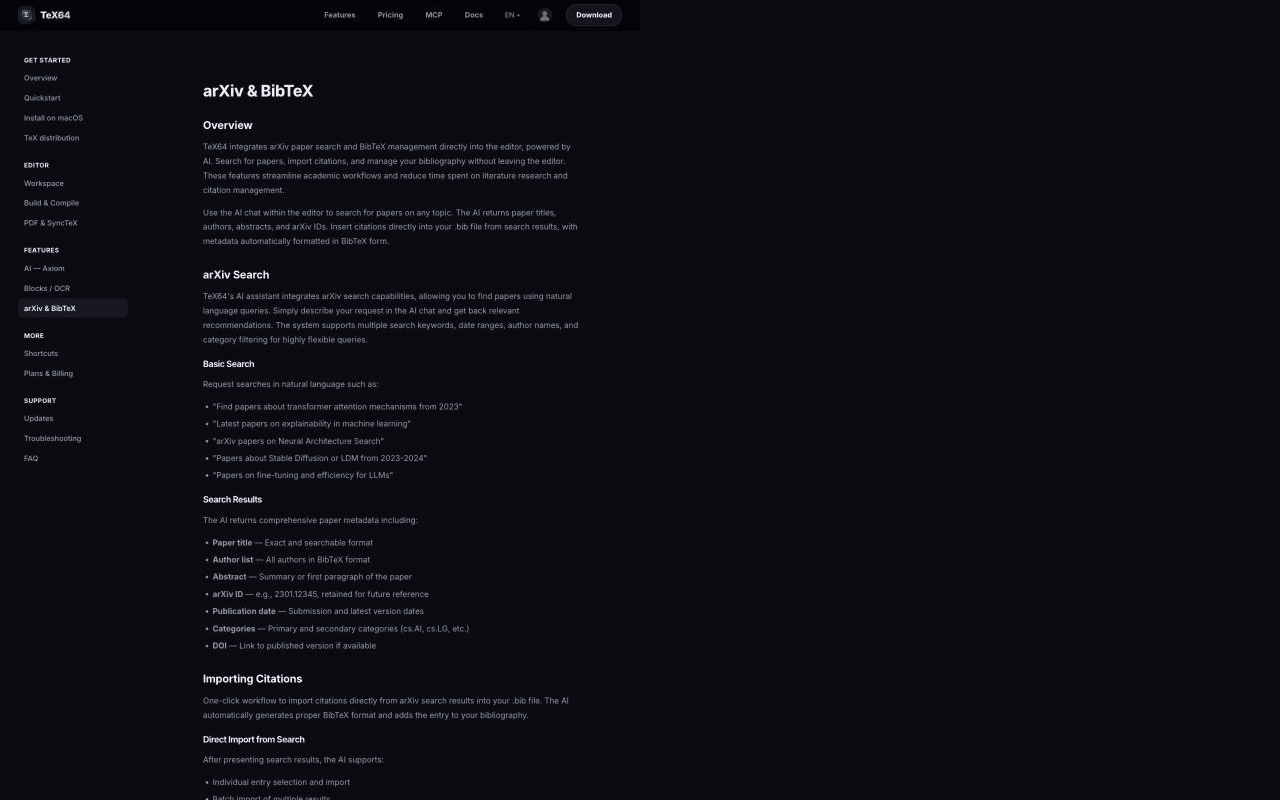
A citation assistant should not begin by composing a plausible-looking BibTeX entry. It should begin with an identifier that the author can check, then preserve enough artifacts to audit every transformation that follows.
Start from an exact arXiv identifier
Discovery and record creation are different operations. A search result is a candidate. After the author selects a paper, the workflow should request metadata for that exact arXiv ID and only then create a bibliography record. The arXiv API manual defines the upstream interface and returned Atom fields.
Preserve a five-artifact provenance chain
| Stage | Artifact | Question it answers |
|---|---|---|
| 1 | Selected arXiv ID | Which record did the author choose? |
| 2 | Returned Atom metadata | What did arXiv report at retrieval time? |
| 3 | .bib diff | What fields and key entered the project? |
| 4 | \cite{key} diff | Where was that key used? |
| 5 | Rendered bibliography | Did the document resolve and typeset the entry? |
Compilation closes the technical chain. It exposes a missing bibliography resource, a mismatched key, or an unresolved reference in the output. It does not validate the intellectual claim around the citation.
TeX64 separates search from exact-ID BibTeX
The inspected Axiom implementation exposes arxiv_search and arxiv_bibtex as separate tools. Search returns candidate titles, authors, abstracts, URLs, and identifiers. Exact-ID retrieval creates a deterministic key in the form arxiv:<id>. The agent prompt requires the bibliography entry to exist before inserting \cite{key}.
candidate search
→ author chooses exact arXiv ID
→ fetch exact metadata
→ write BibTeX entry with deterministic key
→ insert the same key in the manuscript
→ compile and inspect the bibliography
Run one exact-ID fixture through the production code
The public fixture supplies 1706.03762 to the current identifier extractor, passes a cached Atom response through the production metadata parser and BibTeX generator, writes the resulting record and manuscript citation with the actual guarded Axiom tools, and compiles documents/citation/main.tex. The Atom response was retrieved on August 31, 2026 and has SHA-256 cb4480b5….
| Stage | Public artifact | Recorded result |
|---|---|---|
| Exact identifier | 1706.03762 and cached Atom metadata | normalized ID 1706.03762 |
| BibTeX write | arxiv-citation.refs.bib | SHA-256 af45aa1d… |
| Manuscript write | arxiv-citation.diff | SHA-256 eafc7457… |
| Build root | documents/citation/main.tex | success |
| Rendered output | arxiv-citation.pdf | SHA-256 4d2430c6… |
Inspect the generated BibTeX, the source diff, the machine-readable trace, and the compiled PDF directly. The current extractor removes a trailing vN revision suffix, so version retention remains a known limitation rather than a supported claim.
A clean PDF does not establish scholarly support
arXiv metadata does not establish peer review, relevance, claim support, or bibliographic perfection. The author must read the paper, check the selected version, and decide whether the surrounding sentence is supported.
Primary sources
Report changed behavior, failed reproductions, or errors through TeX64 support.